Custom Countertops and the Rock Behind the Label: What Granite Really Means
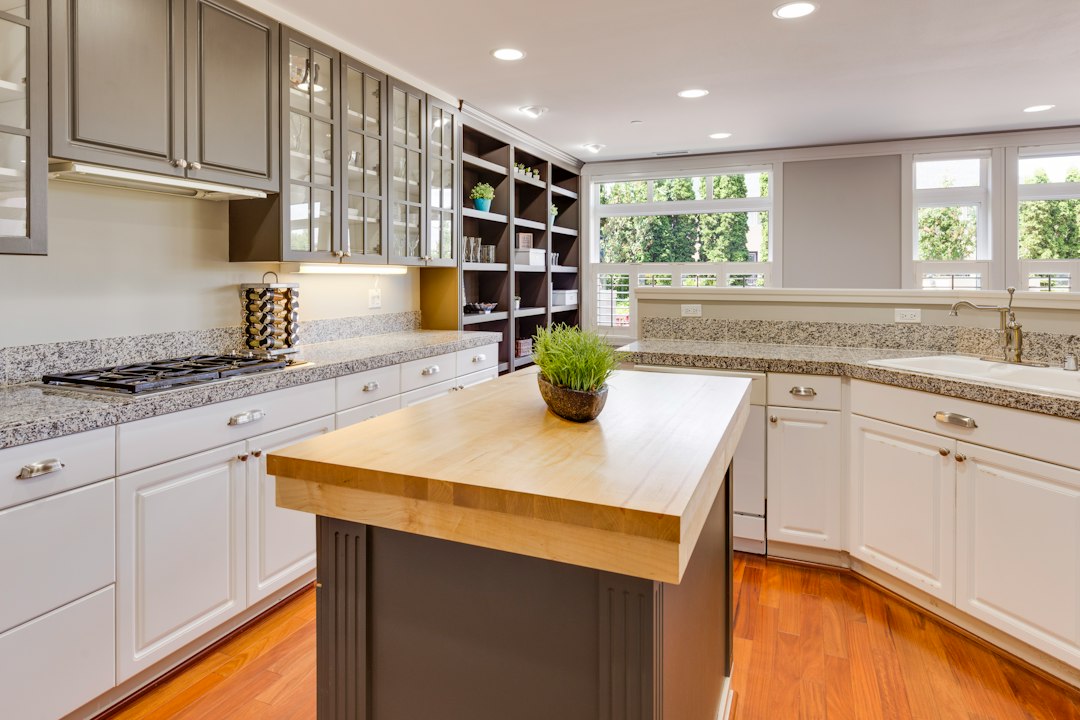
A slab yard runs on one word. It is painted on the rack, printed on the tag, typed into the quote and repeated in the showroom, and most homeowners take it as a statement about what the rock actually is. It is not. It is a commercial sorting term, inherited from a trade that needed a single word for hard silicate stone that holds a polish, shrugs off a hot pan and does not dissolve in vinegar. As a purchasing category it works perfectly well. As a prediction of how one particular slab will behave in one particular kitchen, it is close to useless on its own.
Geologists use the word far more narrowly. In petrology it names a specific intrusive igneous rock: cooled slowly at depth, coarse enough that you can pick out individual crystals with your eye, dominated by feldspar with a real proportion of quartz and a scatter of dark minerals through it. A good share of what reaches a kitchen fits that description exactly. A good share does not, and the ones that do not are neither frauds nor substitutes. They are different rocks that the trade files in the same drawer because they look similar polished and cut on similar machines.
The difference turns up in a fabrication shop long before it turns up in a kitchen. Crews who saw, polish and install granite around Riverside and the wider Inland Empire learn to read a slab's family off its face, because the family sets blade speed, decides whether a narrow section needs reinforcing, governs how the polish comes up and dictates what gets said to the homeowner on the walk through. The homeowner version of that knowledge is much shorter and still worth having, because it quietly changes which slab you should want.
The trade category, and what the standard admits
The dimension stone industry writes its own specifications, and the specification for this material is openly a commercial one. It groups together stone that is visually and mechanically similar for building purposes, which means it covers a family of silicate rocks rather than a single rock type. Gneiss, granodiorite, diorite, gabbro, syenite and anorthosite all sit inside it. Several of those contain no quartz whatsoever.
The same standard sets performance floors, and the one worth remembering is absorption. A stone meeting the specification takes up no more than roughly four tenths of one percent of its weight in water. That is a genuinely low figure, and it is the number behind every claim that this material is low maintenance.
The catch is that a slab is not required to meet a standard in order to be sold under a commercial name. Yards stock plenty of handsome stone that sits well outside those floors, and nobody is lying when they sell it, because the label is a category and not a certificate. If absorption matters to you, it is a question to ask about your specific stone rather than about the word on the tag.
Where the word is literally accurate
A true member of the igneous family is quartz plus feldspar plus accessory minerals, evenly distributed, with a speckled rather than a flowing pattern. Quartz sits at seven on the mineral hardness scale and feldspar at six, which is why a knife will not mark this surface and why grit tracked in on shoes does not dull it. These are the workhorse stones of the trade, the ones a yard labels as granite with no qualifier after it: predictable, strong, dense, widely quarried, and usually the cheapest material on the rack.
They are also the ones most often passed over, because consistent speckle has been out of fashion for a decade. On performance alone, several of them beat anything in the exotic racks.
The dark stones that are not in that family at all
The deep blacks and charcoals, the stones sold as absolute black and the like, are generally gabbro, dolerite or diabase. They are igneous, they are dense, they are often lower in absorption than the speckled stones, and they contain essentially no quartz. Their hardness comes from plagioclase feldspar and pyroxene instead.
Two practical consequences follow. These stones are superb performers against staining and heat, which is why they end up in commercial kitchens. And a high polish on a near black surface shows every water spot, every fingerprint and every streak of hard water mineral, which in this valley is a daily fact rather than an occasional one. A honed or a leathered finish on the same material solves that completely. The stone is not the problem, the gloss is.
Some dark stones in this group also carry small brass coloured specks of iron sulphide. Left under standing water for long enough, those can weep a rust halo. It is uncommon, it is localised, and it is worth knowing about before you build a sink run in a stone full of them.
The banded stones, where direction starts to matter
A great deal of the granite bought for its movement is metamorphic rather than igneous: gneiss, or a migmatite that was partly melted and refolded. The sweeping bands and the swirls that make these slabs desirable are foliation, which is the alignment of mineral grains into parallel layers under pressure.
Foliation gives the stone a direction. It is stronger across the banding than along it, and a thin section cut parallel to a strong band is weaker than the same section cut across it. That is not a defect and it is not fragility in any general sense. It is a property, and it is the reason a careful shop decides slab orientation before it programs a cut, and the reason a narrow rail in front of a sink sometimes gets a steel rod let into a groove on the underside and set in epoxy.
If your slab has dramatic parallel movement, ask which way the bands will run relative to the sink opening. The answer tells you whether anyone looked.
The iridescent and the blue
The stones that flash blue or silver as you walk past them are usually anorthosite, almost entirely plagioclase feldspar, with the shimmer coming from light interference inside labradorite crystals. They are hard, dense and genuinely beautiful, and the effect is directional, which means a seam carrying the flash in one direction next to a piece carrying it in another reads as two different stones. Orientation is part of the layout on these, not a detail.
The ones that are not silicate rock at all
Finally, a small number of stones sold under the same word are not in the family by any reading. Some deep greens are serpentinite. Some pale stones with crystalline sparkle are dolomitic marble. These are carbonate or hydrated magnesium silicate rocks, and they behave accordingly: softer, more porous in places, and reactive to acid. Lemon juice, wine and descaler will etch them, which means dulling the polished surface chemically rather than staining it, and no sealer in existence prevents it.
There is a five minute test that settles this and it costs nothing. Ask for an offcut of your actual stone, put a few drops of lemon juice on the polished face, leave it fifteen minutes and wipe it off. A dull patch means carbonate, and carbonate means either a different stone or different habits at that counter. A surface that is unchanged means you are in the silicate family and acid is simply not your problem.
Mica, pits and the small holes nobody mentions
The other mineral worth naming is mica, in either its dark or its pale form. It is platy, it cleaves into sheets, and it is soft, sitting near calcite on the hardness scale. Many attractive stones sold as granite are full of it, and the flakes catch the light in a way that photographs beautifully.
What mica does on a production line is pull out. Polishing heads lift flakes at the surface and leave shallow pits behind, and this is why factory slabs arrive resin treated: the voids get filled, the fill cures, and the surface comes up uniform. It is standard practice on nearly every imported slab today and it is not something to object to.
The thing to know is that resin fill lives at the surface. Over years, in a heavily used zone, a few pits can reopen, and in a mica rich stone an occasional pit is a feature of the material rather than a failure of the work. You can feel it coming before you buy: run your palm flat and slowly across an unresined offcut or the underside of the slab, and a mica rich stone announces itself.
A high mica content is also why two slabs with the same absorption figure can wear differently. Absorption measures the pore structure. Mica measures how willing the surface is to give something up.
Asking the two questions that get you a real answer
Nearly all of this reduces to two questions, and both of them are ordinary rather than confrontational.
Ask for the stone's commercial name and its country of origin, in writing on the quote. A name plus an origin is searchable, and the technical sheets that importers publish will usually give you absorption, density and flexural strength for that exact material. A quote that names only a colour and a price level has described a category to you.
Ask what rock it actually is, and accept a hedged answer. A fabricator who tells you a slab is probably a gneiss, with real movement and a direction to respect, is telling you considerably more than one who says it is all the same stuff once it is polished. The first answer predicts the sink rail, the seam and the finish. The second predicts nothing.
Then make the easy choices that follow from the answer. A honed finish for a near black stone in a hard water kitchen. A cut orientation decided before the saw runs on a banded slab. An acid test on anything green or unusually crystalline. An offcut kept in a dry cupboard, because it is the only perfect reference your kitchen will ever have.
None of that is maintenance advice and none of it costs anything at the point you can still act on it. It is simply the difference between buying a word and buying a rock.